
Saturday, October 23, 2010


Friday, October 1, 2010

Friday, September 3, 2010

Wednesday, September 1, 2010
FINAL EXAMINATION PART 3 - 1/2 HOUR PAPER - 26 May 2010
Paolo Fang - 21/08/10
Please below the questions from the latest examination short paper - Wednesday 26 May 2010
Please feel free to comment the answers.
MANAGEMENT OF CONSTRUCTION
3.a Briefly describe the difference between Management Contracting and Construction Management.
answer: the distinction between MC and CM lies in the degree to which the client accept to enter into a direct contractual relationship with the work/trade contractors.
In MC contractual relationship is through the manager contractor.
In CM the client appoints directly the work contractors.
3.b Your project has reached Practical Completion under JCT SBC05 contract: what documentation will you issue what are the consequences?
answer: the Architect/Contract Administrator issues a Certificate of Practical Completion. It's the start of Liability Period, half of the retention fee is released to the contractor.
3c. What is a Performance Bond?
answer: a Performance Bond is a Contractual Arrangement between the Employer and a 3rd Party called Guarantor. Under this agreement the guarantor will pay a certain amount of money to the employer if the Contractor won't be able to perform his obligation under the terms of the building contract.
Paolo Fang - 21/08/10
3d. Describe the difference between patent and latent defects.
answer: a Patent Defect is a defect discovered during the reasonable exercise of due diligence by the professional while the Latent Defect is a concealed defect in the workmanship or design not immediately visible.
3e. What are LADs, on what are they based and how are they deducted?
answer: liquidate damages refer to a reasonable amount of money due to the employer by the contractor because of late completion. LADs are stated in the contract particulars and the payment is due after the issue of Non-Completion Certificate
Paolo Fang - 01/09/10
PRACTICE MANAGEMENT AND BUSINESS ADMINISTRATION
4a. You are considering going into partnership with a colleague. List the issues you consider should be incorporated into an agreement.
answer: amount of capital provided by each partner, duties of partner, portions of profit or losses between each partner
4b. What is a RIDDOR?
answer: Reporting of Injuries, Diseases and Dangerous Occurrences Regulations is a legal duty for the employer to report an accident to the HSE.
4c. The HGCR Act 1996 grants three important rights in relation to a party's entitlement to payment- list them
answer: all construction contracts have to contain certain payment provisions such as: (compulsory payments by installments(?)), Paying party must specify to the payee the amount of each payment and the basis on which it has been calculated, withhold payment by the employer must be made under written notice at least 7 days before the due payment date and ground of such withhold has to be specified.
4f. Your practice has insisted that you increase your working hours in the view of their increased work load.You are reluctant to do so as you are preparing for your Part 3 Examination. What are your rights and under what legislation?
answer: Under the EC working time Directive 93/104 the Maximum Weekly working time is 48 hours. The employee is entitled to receive up to 4 weeks annual paid leave.
Paolo Fang - 23/08/10
THE CONTEXT OF PRACTICE
1a. The duties of the ARB are contained within the 1997 Architects Act which covers five main areas: list four of these.
answer: updating Architect Register, investigate complain about architect's conduct/competence, set standard for education, decide qualification needed to become an architect.
1b. What is the role of an RIBA Client Design Advisor?
answer: the RIBA CDA is an independent professional advisor with experience in construction, specially trained to maximize the quality and the value of construction project.
1c. What are the three principles of the RIBA Code of Conduct?
answer:integrity, competence, relationship
1d. What is the role of the Environmental Agency?
answer: EA is a no-departmental public body with the aim to protect and improve the environment and to promote sustainable developments.
1e. Under the Public Sector Directive and Public Contracts Regulations 2006, contracts have to be advertised throughout the EU, however there are three exceptions to these rules- what are they?
answer: 1.contract water, energy, transport and postal service, 2.telecommunication, 3. secret or security measures required
1f. List the primary planning legislation including that related to listed building/conservation areas.
answer: Town and Country Planning Act 1990 - Planning (Listed Building and Conservation Area) Act 1990 - Building Act 1984 - Fire Precaution Act 1971
Paolo Fang - 23/08/10
THE MANAGEMENT OF ARCHITECTURE
2a. What is a BREEAM and what dose it apply?
answer: Environmental Assessed Method for buildings. It sets the standard for best practice in sustainable design and it's used to describe a building environmental performance.
2b. Under the Party Wall Act 1996, what is the role of the 3rd surveyor and at what stage is he/she appointed ?
answer: the third surveyor is appointed when the client's surveyor and the adjoining property's surveyor don't reach an agreement. His role is to 'settle the dispute'.
2c. What means are available to a Local Planning Authority to prevent the continuation of a development which is in breach of planning control?
answer: the LPA can issue an Enforcement Notice to stop the development which is in breach of planning control.
Paolo Fang - 02/09/10
2d. Give three examples of easement.
answer: right of light, right of way, right of support.
2e. What is a section 106 Agreement?
answer: S 106 of the TCPA 1990 is an agreement between the developer and the LPA. The developer provide infrastructures to mitigate the impact of the proposed development to the local community. eg. Westfield Ltd has provided a new library with the new Shopping Centre in Fulham and Hammersmith Borough Council.
2f. Wha is an SPV? Also briefly describe its function.
answer: Special Purpose Vehicle is a legal entity created to fulfill specific objective. The main financial reason behind its creation is to reduce the risk.
http://www.alway-associates.co.uk/legal-update/article.asp?id=68
Paolo Fang - 02/09/10
Please below the questions from the latest examination short paper - Wednesday 26 May 2010
Please feel free to comment the answers.
MANAGEMENT OF CONSTRUCTION
3.a Briefly describe the difference between Management Contracting and Construction Management.
answer: the distinction between MC and CM lies in the degree to which the client accept to enter into a direct contractual relationship with the work/trade contractors.
In MC contractual relationship is through the manager contractor.
In CM the client appoints directly the work contractors.
3.b Your project has reached Practical Completion under JCT SBC05 contract: what documentation will you issue what are the consequences?
answer: the Architect/Contract Administrator issues a Certificate of Practical Completion. It's the start of Liability Period, half of the retention fee is released to the contractor.
3c. What is a Performance Bond?
answer: a Performance Bond is a Contractual Arrangement between the Employer and a 3rd Party called Guarantor. Under this agreement the guarantor will pay a certain amount of money to the employer if the Contractor won't be able to perform his obligation under the terms of the building contract.
Paolo Fang - 21/08/10
3d. Describe the difference between patent and latent defects.
answer: a Patent Defect is a defect discovered during the reasonable exercise of due diligence by the professional while the Latent Defect is a concealed defect in the workmanship or design not immediately visible.
3e. What are LADs, on what are they based and how are they deducted?
answer: liquidate damages refer to a reasonable amount of money due to the employer by the contractor because of late completion. LADs are stated in the contract particulars and the payment is due after the issue of Non-Completion Certificate
Paolo Fang - 01/09/10
PRACTICE MANAGEMENT AND BUSINESS ADMINISTRATION
4a. You are considering going into partnership with a colleague. List the issues you consider should be incorporated into an agreement.
answer: amount of capital provided by each partner, duties of partner, portions of profit or losses between each partner
4b. What is a RIDDOR?
answer: Reporting of Injuries, Diseases and Dangerous Occurrences Regulations is a legal duty for the employer to report an accident to the HSE.
4c. The HGCR Act 1996 grants three important rights in relation to a party's entitlement to payment- list them
answer: all construction contracts have to contain certain payment provisions such as: (compulsory payments by installments(?)), Paying party must specify to the payee the amount of each payment and the basis on which it has been calculated, withhold payment by the employer must be made under written notice at least 7 days before the due payment date and ground of such withhold has to be specified.
4f. Your practice has insisted that you increase your working hours in the view of their increased work load.You are reluctant to do so as you are preparing for your Part 3 Examination. What are your rights and under what legislation?
answer: Under the EC working time Directive 93/104 the Maximum Weekly working time is 48 hours. The employee is entitled to receive up to 4 weeks annual paid leave.
Paolo Fang - 23/08/10
THE CONTEXT OF PRACTICE
1a. The duties of the ARB are contained within the 1997 Architects Act which covers five main areas: list four of these.
answer: updating Architect Register, investigate complain about architect's conduct/competence, set standard for education, decide qualification needed to become an architect.
1b. What is the role of an RIBA Client Design Advisor?
answer: the RIBA CDA is an independent professional advisor with experience in construction, specially trained to maximize the quality and the value of construction project.
1c. What are the three principles of the RIBA Code of Conduct?
answer:integrity, competence, relationship
1d. What is the role of the Environmental Agency?
answer: EA is a no-departmental public body with the aim to protect and improve the environment and to promote sustainable developments.
1e. Under the Public Sector Directive and Public Contracts Regulations 2006, contracts have to be advertised throughout the EU, however there are three exceptions to these rules- what are they?
answer: 1.contract water, energy, transport and postal service, 2.telecommunication, 3. secret or security measures required
1f. List the primary planning legislation including that related to listed building/conservation areas.
answer: Town and Country Planning Act 1990 - Planning (Listed Building and Conservation Area) Act 1990 - Building Act 1984 - Fire Precaution Act 1971
Paolo Fang - 23/08/10
THE MANAGEMENT OF ARCHITECTURE
2a. What is a BREEAM and what dose it apply?
answer: Environmental Assessed Method for buildings. It sets the standard for best practice in sustainable design and it's used to describe a building environmental performance.
2b. Under the Party Wall Act 1996, what is the role of the 3rd surveyor and at what stage is he/she appointed ?
answer: the third surveyor is appointed when the client's surveyor and the adjoining property's surveyor don't reach an agreement. His role is to 'settle the dispute'.
2c. What means are available to a Local Planning Authority to prevent the continuation of a development which is in breach of planning control?
answer: the LPA can issue an Enforcement Notice to stop the development which is in breach of planning control.
Paolo Fang - 02/09/10
2d. Give three examples of easement.
answer: right of light, right of way, right of support.
2e. What is a section 106 Agreement?
answer: S 106 of the TCPA 1990 is an agreement between the developer and the LPA. The developer provide infrastructures to mitigate the impact of the proposed development to the local community. eg. Westfield Ltd has provided a new library with the new Shopping Centre in Fulham and Hammersmith Borough Council.
2f. Wha is an SPV? Also briefly describe its function.
answer: Special Purpose Vehicle is a legal entity created to fulfill specific objective. The main financial reason behind its creation is to reduce the risk.
http://www.alway-associates.co.uk/legal-update/article.asp?id=68
Paolo Fang - 02/09/10
Friday, August 27, 2010
Friday, July 30, 2010
Sunday, July 11, 2010
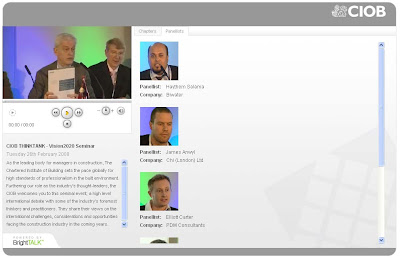
MANAGING THE RISK OF DELAYED COMPLETION
A short Video about managing the risk of delayed completion in construction, presented by the President of the CIOB (The Chartered Institute of Building). Please click the link below

For others CIOB videos click here
For others CIOB videos click here
THE PROFESSIONAL INTERVIEW
What the purpose of the Professional interview?
The main purpose of the interview is to determine the professional maturity of the candidate and his/her competence to practice architecture based on the documentary submitted: - P.E.D.R. - Professional Career Evaluation / CV - Written examinations (Short paper and Case Scenario) - Case Study
What the examiners expect from candidates?
The examiners expect the candidates to demonstrate an understanding about their obligations and responsibilities as professionals and testing their judgement and reflective skills.
What is the format of the interview?
There are 2 examiners who assess your documentary submission. There are a maximum of 6 candidates per day and the interview can take about 1 hour. You may be asked to explain inconsistency/discrepancy between your works (i.e. PEDR and Case Study). You may be asked some questions from the examination papers and about other topical issues. At the end of the session you will be asked if you would like to say or add anything further.
What are the key aspects of the interview?
- Be aware of your weaker areas.
- Prepare yourself simulating mock test with your group study.
- Speak with students who have already taken the Professional Interview.
OTHER USEFUL SOURCE OF INFORMATION ABOUT THE PROFESSIONAL INTERVIEW:
- LSBU Course Guide (paragraph Professional Interview - page 6)
- PART 3 HANDBOOK - Stephen Brookhouse (Chapter 5 - The Oral Examinarion)
- RIBA Website - (Part 3 Professional Examiners)
- APSAA (Association of Professional Studies Advisors in Architecture).
Thursday, July 8, 2010
CONSTRUCTION INDUSTRY JOURNALS

There are many journals which are covering legal and professional practice topics of the construction industry. Please find below a short list:
- The Contruction Law Journal covers contractual and other legal matters in the construction industry. Click here to see Sample Issue and Contents of Recent Issues.

- Construction News has the latest regional and national costruction news for the construction industry. Please click here to access the free website

- Building Design is one of the most popular weekly magazine among the British Architects. It offer a section dedicated to legal and office management matters. Please click here to visit the relevant section.

- Building offers an interesting section about Contracts and Procurements and Case Law. Please visit here the relevant section.

Monday, July 5, 2010
The Management of Construction
The employer has contested the value of the latest interim certificate. What action
must he take in order that he is not in breach of the JCT SBC 05 contract?
Under clause 4.13.4 the Employer must give written notice to the Contractor specifying any amount proposed to be withheld/deducted from the amount due and the ground for such withholding, not later than 5 days before the final date for payment.
(Final Payment = 4.13.1 The final date for payment pursuant to an Interim Certificate shall be 14 days from the date of issue of that Interim Certificate).
What is the contractual status of:
a. an information-release schedule and
b. a contractor's programme
The Infomation-release schedule is an optional provision within the SBC05 that states what kind of information will be release by the Architect/Contract Administrator to the Contractor and when. The contractual implication for a later release than the stipulated day can be consider a Relevant Event in relation to an extension of time claimed by the Contractor
(see Guide to SBC Sarah Lupton and SBC/Q 2005)
must he take in order that he is not in breach of the JCT SBC 05 contract?
Under clause 4.13.4 the Employer must give written notice to the Contractor specifying any amount proposed to be withheld/deducted from the amount due and the ground for such withholding, not later than 5 days before the final date for payment.
(Final Payment = 4.13.1 The final date for payment pursuant to an Interim Certificate shall be 14 days from the date of issue of that Interim Certificate).
What is the contractual status of:
a. an information-release schedule and
b. a contractor's programme
The Infomation-release schedule is an optional provision within the SBC05 that states what kind of information will be release by the Architect/Contract Administrator to the Contractor and when. The contractual implication for a later release than the stipulated day can be consider a Relevant Event in relation to an extension of time claimed by the Contractor
(see Guide to SBC Sarah Lupton and SBC/Q 2005)
Subscribe to:
Posts (Atom)